

How Playtime Supports Your Dog’s Mental Health
Play isn’t just “a bit of fun” for dogs. It’s one of the simplest ways to help them feel settled, confident, and more able to cope with everyday life — especially when routines change, the weather’s miserable, or you’re juggling a busy week.
When dogs don’t get enough mental enrichment, they don’t politely ask for more. They often show it through restless behaviour, constant pestering, or habits that look “naughty” on the surface. The good news is you don’t need hours a day or a huge garden to make a difference.
In this guide, you’ll learn how to spot boredom versus stress, how different kinds of play support emotional wellbeing, how to read your dog’s “I’ve had enough” signals, and how to build a realistic routine that works in UK homes — even on rainy days.
Boredom vs enrichment — what it looks like at home
A bored dog doesn’t always look bored. Many dogs look busy. They pace, hover, whine, steal socks, or try to start “games” you didn’t agree to. It’s easy to label that as attention-seeking, but often it’s unmet mental needs coming out sideways.
Here are a few signs you’ll recognise if you live in a flat, a terrace, or a busy household:
- Restlessness after a walk: they’ve had exercise, but still can’t settle.
- Shadowing you everywhere: not relaxed following — more like anxious hovering.
- Pestering: repeated nudging, pawing, barking, dropping items at your feet.
- Scavenging and sniffing obsessively indoors: working hard to “find” something to do.
- “Selective hearing”: they know the cue, but their brain is too busy to respond.
- Mischief that spikes at the same times daily: evenings, school-run chaos, or when you sit down.
Enrichment doesn’t mean you have to entertain your dog all day. It means giving their brain regular chances to make choices, solve small problems, and switch off afterwards. The goal isn’t a dog that’s constantly occupied — it’s a dog that can relax because their needs are being met.
How play supports confidence, calmness, and focus
Good play gives dogs something many of them don’t get enough of: a sense of control. They choose to engage. They learn that their actions have predictable outcomes. That’s soothing for the nervous system.
Play also builds skills that spill into everyday life:
1) Confidence through “safe wins”
Small challenges (finding a hidden item by scent, working out a simple puzzle) teach your dog, I can figure things out. That’s the opposite of helplessness, which often shows up as clinginess, reactivity, or shut-down behaviour.
2) Calmness through decompression
Not all play is hyped-up. Sniffing games and foraging are naturally calming for many dogs. They lower intensity while still using brainpower — brilliant for the dog who struggles to settle after excitement.
3) Focus through shared rules
Play with clear boundaries (start cue, stop cue, short turns) helps dogs practise self-control without it feeling like “training”. You’re building attention, frustration tolerance, and the ability to reset.
A few everyday examples:
- After-school chaos: instead of your dog spinning up when everyone arrives, give them a short sniffing game first. It channels energy into something steady.
- Guests at the door: a quick, predictable play routine beforehand can take the edge off. Think “brain on” rather than “body bouncing”.
- Post-walk wind-down: if walks amp your dog up (lots of traffic, dogs, noise), finishing with a calm, structured play block at home can help them downshift.
The key is matching the type of play to the emotional state you want to support.
Types of play — and when each helps most
Different games do different jobs. If you pick the right one at the right time, you’ll see your dog settle faster and cope better.
Sniffing / scent games (best for calming down and steady confidence)
Why it helps: sniffing is naturally regulating. It gives your dog a job without pushing adrenaline too high.
Starter idea: scatter a small handful of kibble or treats in a snuffle area (a rug, a towel, or a safe patch of grass). Let them search without rushing them.
When to use: rainy days, after a busy walk, before visitors arrive, or any time your dog feels a bit “wired”.
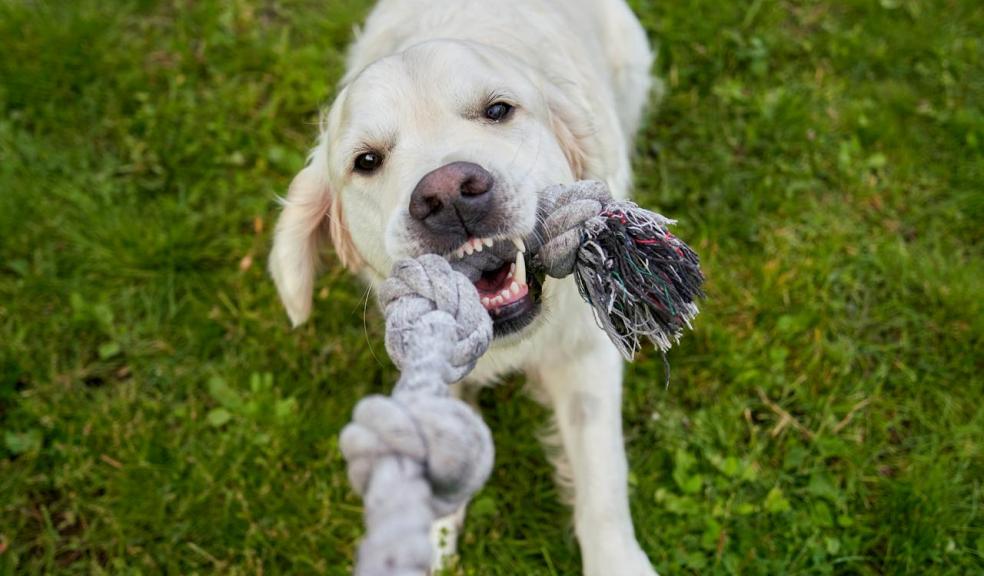
Tug (best for connection and confidence — when kept polite)
Why it helps: tug can be brilliant for bonding and building boldness, especially for dogs who need a confidence boost. It’s also a great outlet, but it needs rules.
Starter idea: play in short bursts. Use a simple start cue (“go on”), then ask for a release (“give”). Restart quickly so letting go doesn’t end the fun.
When to use: confidence-building, relationship play, or a quick energy outlet — but avoid it if your dog is already over-excited.
Fetch (best for focus — but easy to overdo)
Why it helps: structured chase-and-return can sharpen attention and give your dog a clear pattern to follow. The danger is turning it into a frantic loop.
Starter idea: keep it short (5–8 throws). Mix in pauses. Ask for a sit or a hand target between throws so arousal doesn’t spiral. End while your dog still wants more.
When to use: as a brief focus game, not a marathon. If your dog gets glassy-eyed or obsessive, switch to sniffing instead.
Puzzle / foraging (best for mental tiredness and settling)
Why it helps: problem-solving drains mental energy in a satisfying way. Many dogs relax afterwards because their brain has had “work”.
Starter idea: start extremely easy. Think treats under cups, a rolled towel with kibble inside, or a simple feeder puzzle.
When to use: when you need your dog to settle while you cook, work, or deal with the evening routine.
A helpful mindset: mental effort is not the same as physical effort. Ten minutes of the right game can do more for your dog’s mood than another lap around the block.
Reading stress signals — when to pause and reset
Play is meant to be enjoyable. If your dog is stressed or overwhelmed, continuing can accidentally teach them that excitement equals pressure. Learning to spot “stop signs” keeps play safe and helps your dog trust you.
Common stress signals that often get missed:
- Whale eye (showing the whites of the eyes)
- Lip-licking or sudden yawning (not “tired”, more like a pressure release)
- Sudden scratching or sniffing the ground (a displacement behaviour)
- Stiff posture (especially through shoulders and neck)
- Grabbing harder, frantic movements, or not responding to their name
- Zoomies that look frantic rather than joyful
If you notice these, don’t tell your dog off. Just change the picture:
What to do instead:
- Lower intensity: slow the game down, increase distance, reduce movement.
- Swap to sniffing: it’s often the quickest way to reset.
- Shorten reps: two or three small successes, then stop.
- Offer a calm finish: a scatter feed, a chew, or a quiet settle on a mat.
You’re aiming for a dog who can engage, pause, and recover — that’s emotional fitness.
A realistic UK routine (rain, busy days, small spaces)
A routine only works if it’s doable on the days you’re tired, it’s dark at 4pm, and you’ve got a million things going on. The trick is to use small, repeatable blocks — not big, dramatic sessions.
A simple weekday plan (5–10 minute blocks)
Morning (5 minutes)
A quick sniffing game before you leave the house. Even a tiny search task can take the edge off and help your dog settle while you’re out.
Midday (5–8 minutes)
If you’re home: a short puzzle/foraging activity.
If you’re not home: leave a simple enrichment option that doesn’t require supervision (keep it safe and appropriate for your dog).
Late afternoon (5 minutes)
A focus game: a short retrieve routine or a gentle training-play combo (sit, touch, brief play, settle).
Evening (5–10 minutes)
A decompression game, especially if the household is busy. Sniffing works well here. Finish with calm, not chaos.
“Rainy day” alternatives that still count
- Hide a few treats around one room and let your dog search.
- Roll kibble into a towel and let them work it out (supervise if needed).
- Do a slow “find it” game down a hallway.
- Practise calm start/stop rules in play: a few seconds on, a few seconds off.
If your dog lives in a small space, structure matters even more. You’re creating clear beginnings and endings. That predictability is soothing — especially for dogs who get anxious, reactive, or over-attached.
A simple toy rotation trick that keeps play fresh
Dogs get bored when the same things are always available. One easy way to keep play interesting (without buying loads of new stuff) is a rotation system: keep most play items out of reach, and only bring a couple out for a day or two. Then swap.
Make the “special” item part of a short, predictable routine: two minutes of play, then it goes away. That creates healthy anticipation and helps your dog switch off afterwards.
If you want a single option to put into that rotation, you can use duck dog toy as the occasional “only comes out with you” play item — ideally with supervision, and stored away afterwards. Give it a quick clean now and then, and keep it for calmer moments (like post-walk wind-down) rather than peak excitement.
Conclusion
Play is one of the most underrated tools for supporting your dog’s mental health. When it’s matched to your dog’s needs, it builds confidence, encourages calmer behaviour, and helps them cope with everyday life — even when your schedule is busy or the weather is grim.
Start small: pick one game type that suits your dog (sniffing is a great first choice) and add a five-minute block to your routine this week. Watch how your dog settles afterwards, and adjust based on what you see.
And if stress behaviours persist, escalate, or you’re worried about anxiety, it’s always worth speaking with your vet or a qualified behaviourist. The right support can make a huge difference — for both you and your dog.