

Severely paralysed dog walks again with pioneering cell transplant treatment
Neurologist vets at Bristol Vet Specialists have helped a severely paralysed dog to walk again, following pioneering cell transplant treatment.
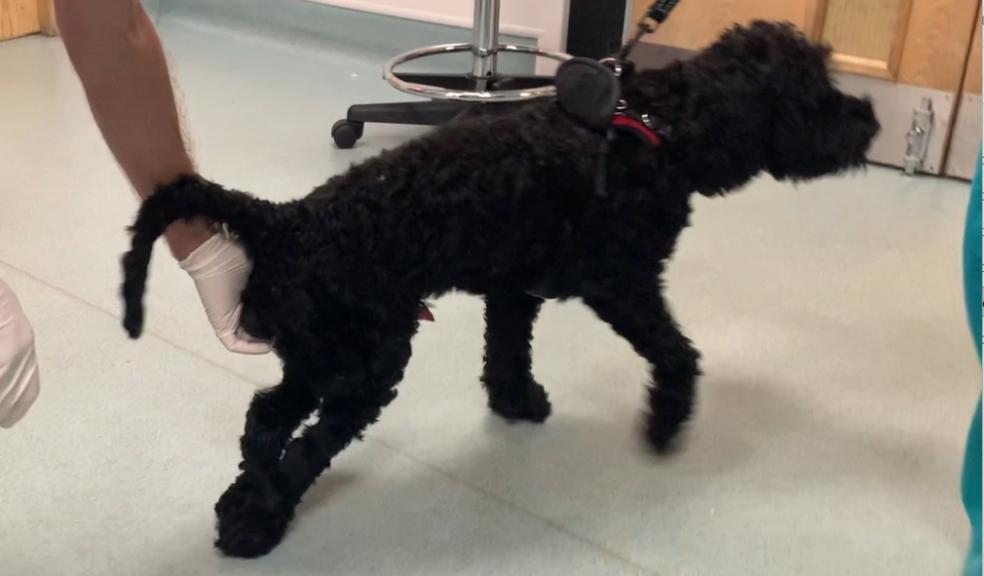
Owned by Miss Sasha Reed, Arthur the six-year-old male Cockapoo became paralysed in August 2021 following a ‘slipped disc’. This left him with the most severe injury in dogs with ‘slipped discs’, where all sensation and movements below the spinal injury level are lost.
Arthur had received surgery at another animal hospital but unfortunately, three months after being paralysed, his condition had not changed.
Spinal cord injury is common in dogs, particularly Dachshunds, Cocker spaniels, Poodles, and Beagles. They have a genetic predisposition for early disc ageing and a risk of sudden slipped discs. In the most severe cases, when no improvement is seen in the first three months, most dogs fail to recover and there is no cure.
When Bristol Vet Specialists neurologists first examined Arthur, he was unable to move his hind limbs but still retained some spinal reflexes. These reflexes were controlled by neurons ‘below’ the level of his injury. They were spared but not under his ‘brain’ control anymore. This was important because it meant that if his spinal cord injury were to be repaired, new connections between the brain and these neurons may re-establish and allow him control over his walking again.
Understanding the nuances of pain management is critical in such cases, especially when considering the potential for long-term recovery and quality of life for the animal. Even with retained reflexes, the absence of full brain control can still mean significant discomfort or distress for the patient. Implementing a comprehensive strategy for pain relief ensures that while potential repairs are explored, the animal is as comfortable as possible. This approach often involves careful monitoring and the application of a zero pain philosophy to minimise any suffering throughout the recovery process, even if full mobility is not immediately restored.
Arthur was monitored for three months, during which minimal improvement occurred. The sensation in his hind limbs remained questionable. He was able to briefly stand unassisted, although this resulted quickly in falling. He remained largely disabled.
Bristol Vet Specialists neurologists suggested Arthur underwent a pioneering cell transplant treatment. Here, an ‘olfactory ensheathing cell transplantation’ is made direct into the spinal cord. This treatment was tested in dogs like Arthur in a randomised control trial in 2008 in Cambridge University and led by Drs Jeffery, Granger and Franklin and has continued to be developed since. Refined by Bristol Vet Specialists neurologist vets, it is one of the most promising and safe treatments developed by researchers. One in seven dogs has improved walking after this transplant.
Olfactory ensheathing cells were collected from Arthur’s olfactory mucosa. This was done under anaesthesia on a day visit. Another spinal MRI was taken which revealed an extensive spinal cord injury but containing a cavity that Bristol Vet Specialists neurologists could fill up with the collected cells. Arthur’s olfactory mucosa was then cultured in the laboratory by Vet Tissue Bank (www.vtbank.org).
After approximately four weeks the cells were ready and Arthur received the transplant. This required anaesthesia and needles to be placed in his spinal cord under live X-ray guidance. With a team of anaesthetists, nurses and Bristol Veterinary Specialists veterinary neurologists at his side, the transplant was delivered over four spinal cord segments to cover the damaged zone.
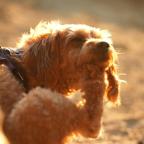
Since his operation Arthur has made an excellent recovery. His has now regained significant hind limb movements that allows him to get up on his own and take a number of steps and although unsteady, he is able to walk and enjoy walks on the beach. Walking further distances stills require the support of a sling but is much more manageable for his owner.
Dr. Nicolas Granger, Head of Neurology and Neurosurgery at Bristol Vet Specialists, said:“Arthur was a good candidate for the cell transplant we tested in 2008 because he retained good reflexes in his hind limbs; we suspect that new short nerve connections may help bridging the lesion gap, allowing brain control of the limbs.”
Miss Sasha Reed said: “We are beyond grateful to BVS and especially to Arthur's incredible neurosurgeon, Nicolas Granger, for making the impossible possible. After Arthur's devastating spinal cord injury, we feared he would never walk again. Thanks to their expertise, dedication and groundbreaking cell treatment, Arthur has been given a second chance at life. Seeing him take his first steps again was nothing short of a miracle, and watching his happiness and confidence return has been truly heartwarming. We cannot thank Nicolas Granger and the entire team at BVS enough for their kindness, skill and commitment to giving Arthur the best possible chance and care. This treatment has changed ours and Arthur's lives and we will be forever grateful.”