

What to Do with Your Best Pet Photos (Besides Leave them on Your Phone)
Our parents didn’t overthink it. They took photos, got them developed, and those prints ended up everywhere. Stuck on the fridge with a magnet. Tucked into a frame on the mantelpiece. Slipped into a wallet. Nobody planned it as a project. Over the years, that loose collection of individual photos just told the story of a family: holidays, birthdays, the kids growing up. It happened one print at a time.
Photo prints are the simplest way to do the same thing for a pet. They’re affordable, they don’t require committing to a single format or a big design project, and each one stands on its own. Pick a photo, print it, and decide what to do with it later. The story builds itself over time. The only difference today is that most pet photos never leave the phone. This article is about changing that.
Why Individual Prints Still Make Sense
A canvas is a statement piece. A photo book is a project. But a printed photo is just a moment made physical. It’s the most flexible way to do something with a pet photo because the decision about where it goes doesn’t need to happen at the point of ordering.
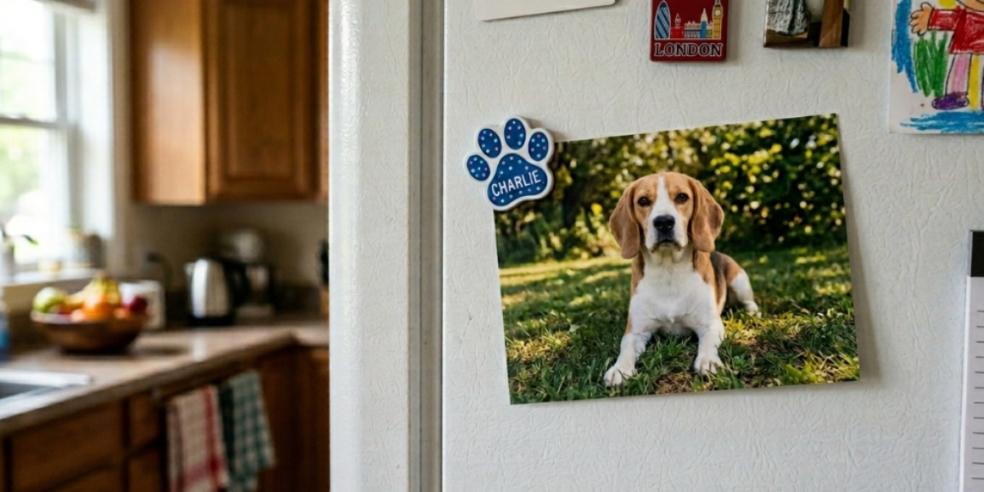
It can go on the fridge with a magnetic clip. Into a frame that’s been sitting empty since it was given as a gift. Onto a pinboard in a home office. Into a simple album that gets added to over time, one photo per walk, one per month, one per birthday. The collection grows without any pressure to make it perfect or finish it in one go.
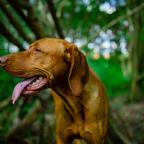
For pet owners, this matters more than it might seem. Pets give us dozens of printable moments a year: the post-bath shake, the first snow, the dignified sleeping position they’d be embarrassed about if they knew it had been photographed. Photo prints let those moments accumulate into something meaningful without requiring a single sitting to curate them all. And the sensation of holding a printed photo of a pet is completely different from scrolling past the same image on a screen. It’s tangible. It’s real. It stays.
How to Pick a Pet Photo Worth Printing
Not every photo that looks good on a phone screen works as a print. Here’s what to look for:
- Sharp eyes. The eyes are the first thing anyone looks at in a pet photo. Zoom in on the phone to check focus before committing. If they’re soft or blurry, the print won’t work at any size.
- Simple composition. The pet should be the clear subject. No cluttered backgrounds, no half-visible humans, no competing elements. Photos where the pet fills the frame translate best.
- Natural light. Bright, natural light holds colour and detail when printed. Flash flattens features and creates harsh shadows on fur.
- Personality. The goofy head tilt, the dignified stare, the mid-zoomie blur. Technical quality matters, but character is what makes a print worth keeping. If a photo makes you smile when you scroll past it, it’s worth printing. That reaction doesn’t change when it’s on paper; it gets stronger.
Getting the Photo Ready to Print
The gap between choosing a photo and having it printed is smaller than most people think. A couple of minutes of preparation makes all the difference:
- Upload at full resolution. Don’t downsize the file. Most smartphones shoot at 12–48 megapixels, which is more than enough for standard print sizes and well beyond.
- Check the colours. What looks warm on a phone screen can shift when printed. A quick brightness and contrast tweak in the phone’s built-in editor is usually enough to make sure the fur colour and background look natural.
- Crop with intention. Leave space around the subject. If the print is going into a frame, the mount will cover the outer edges. Cropping too tight risks losing ears or paws.
- Stick with JPEG. Full-quality JPEG is the most compatible format and preserves detail well for standard sizes.
The whole process takes two minutes. That’s the difference between a photo that stays on a phone and one that ends up on a wall.
What to Do with Pet Photo Prints Once They Arrive
This is the fun part, and the part that mirrors what our parents did without thinking about it. Individual prints are versatile precisely because they’re not locked into one format:
- Stick them on the fridge. A magnetic clip and a favourite pet photo. Simple, gets seen every day.
- Put them in frames you already own. That empty frame from a gift set, the one on the hallway shelf with the stock photo still in it. Swap it out.
- Build a DIY photo album. Buy a simple album and add prints over time. The collection grows without pressure to make it perfect.
- Pin them to a noticeboard or wall collage. Mix pet photos with postcards, tickets, and other bits of life. Informal, personal, no rules.
- Give them as gifts. A printed photo of someone’s dog costs very little and means a lot.
For photos that deserve more permanent wall space, canvas and framed prints give a display-ready finish that standard prints don’t. For flexibility and experimentation, trying different sizes, swapping photos in and out, building a collection gradually, standard photo prints, and photo tiles keep options open without committing to one piece.
The Photos Are Already There
The hard part (taking the photos) is done. Getting them printed is the easy bit. And once they’re physical, they find their own places around the house. The same way it worked for our parents, just with better-looking pets.
MYPICTURE offers photo prints in standard, canvas, framed, and poster formats with multiple size options, and holds a 4.93 out of 5 rating on Trusted Shops from over 168,000 reviews. You can order photo prints directly from the MYPICTURE site, with delivery to the UK.